
June 18, 2026
Stephen Herzog, Allison Berke, Yanliang Pan, William Potter, Douglas Shaw
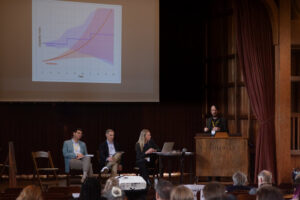
In April, more than 100 experts gathered at California’s Asilomar Conference Grounds to discuss how AI may affect nuclear and biological weapons. Image: Eduardo Fujii
The following is an excerpt from the Bulletin of the Atomic Scientists.
On April 7th, Anthropic announced that it was restricting public access to its most advanced artificial intelligence (AI) model, Claude Mythos Preview, because the system could discover and exploit unknown security vulnerabilities in software. The developer is far from alone in these concerns; such risks extend well beyond hacking and digital security.
A major industry safety report from 2026 found that several frontier AI labs have recently added restrictions to their systems since they could not rule out that their models might assist novices in developing chemical or biological weapons. AI companies usually become aware of serious risks long before governments and international organizations can respond, making their involvement in shaping oversight rules critical from the start. But when it comes to restricting their own commercially valuable AI models, the industry has often stopped short. Moving beyond ad hoc restraint requires a standing forum where AI developers and outside security experts can jointly determine which emerging capabilities warrant closer scrutiny or limits.
Against that backdrop, the James Martin Center for Nonproliferation Studies convened a host of experts on April 8 and 9 at California’s Asilomar Conference Grounds. The setting was fitting, as Asilomar has long been associated with landmark efforts to govern transformative technologies. More than 100 experts gathered to discuss how AI may affect nuclear and biological weapons. Participants included representatives from universities, think tanks, research institutions, the national laboratories, governments, and crucially, the AI industry. The meeting launched a new Asilomar Process to develop practical safeguards for AI-related nuclear and biological risks as the technology continues to advance.
AI will affect nuclear and biological threats in different ways, but those ways connect to common governance problems. Relevant private sector AI models are developing much faster than the institutions tasked with preventing nuclear war and catastrophic biological events. AI companies may be the first to recognize new capabilities, but weapons and conflict experts are needed to judge when those capabilities create concrete security risks. As such, seven principles arose from the recent Asilomar conference intended to address this challenge. Each of these principles can be translated into new practices by AI labs, governments, and international organizations.
Continue reading at the Bulletin of the Atomic Scientists.


